


"Launch of the First International Scientific Conference "The Bekaa in History… People, Place, and Memory
1 week ago
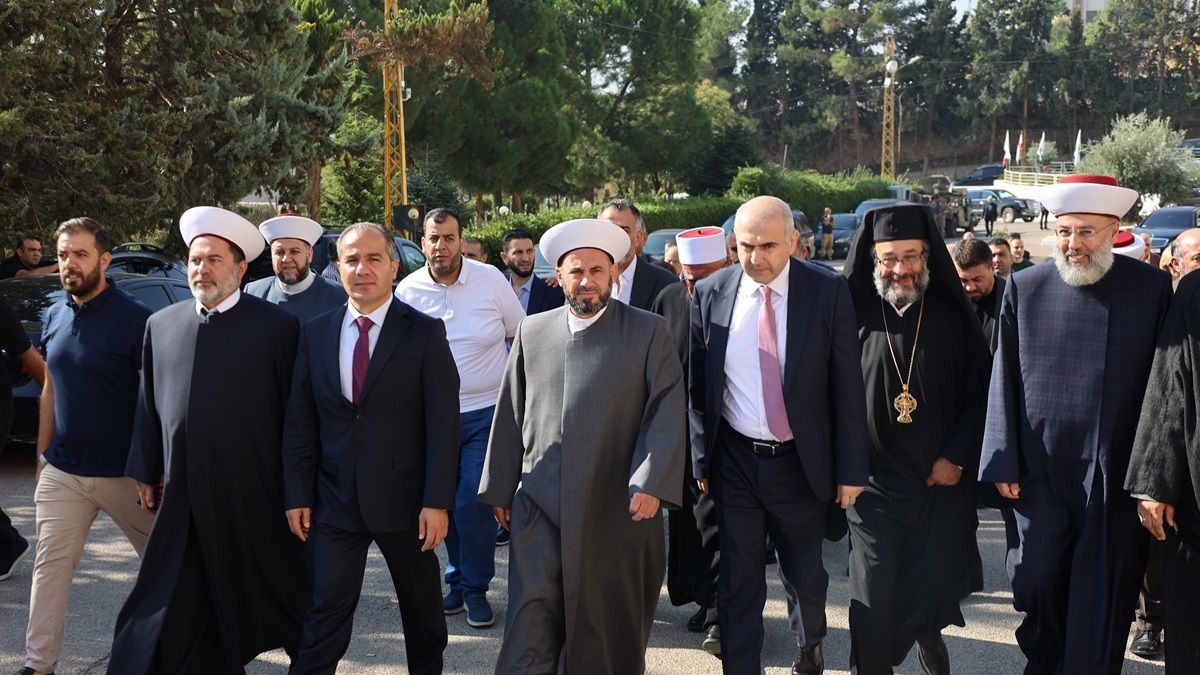
Under the patronage of the President of the Lebanese University, Professor Bassam Badran, and organized by the Department of History at the Lebanese University’s Faculty of Arts and Humanities, Branch IV, in cooperation with the Scientific Research Center at Azhari Bekaa, the Arab Center for Research and Policy Studies, the Lebanese International University, and the Union of Arab Academics and Scholars, the First International Scientific Conference, entitled “The Bekaa in History… People, Place, and Memory,” opened at Azhari Bekaa.
The opening ceremony was attended by prominent religious and spiritual leaders, dignitaries, members of the Higher Islamic Sharia Council, Sharia judges, scholars, academics, researchers, government officials, political figures, party representatives, municipal presidents, village mayors, representatives of security agencies, media institutions, scouting and cultural organizations, and participants from various sectors.
The conference brings together distinguished male and female researchers from Lebanon and several Arab countries. Its program features 90 research papers presented across 15 sessions over two days, exploring the history of the Bekaa from ancient and medieval times through the modern and contemporary periods.
The conference proceedings were introduced by the Director of the Scientific Research Center, Dr. Sheikh Nader Jomaa. The opening ceremony began with a recitation of verses from the Holy Quran, followed by the Lebanese national anthem.
In his address, the Mufti of Zahle and the Bekaa, Dr. Sheikh Ali Al-Ghazzawi, emphasized that understanding the history of the Bekaa is inseparable from understanding Lebanon’s present and future. He stressed that the Bekaa is not a peripheral region of the state but an essential component of the nation’s identity and formation, calling for balanced development that preserves the region’s role and national standing.
Al-Ghazzawi stated, “The Bekaa is not merely a source of livelihood; it is the lung of Lebanon,” warning that this vital region is suffering from environmental and developmental challenges, particularly those affecting water resources, agriculture, roads, and infrastructure.
He stressed the need for comprehensive and lasting solutions to these crises, asking, “Is it not time to pursue a fundamental solution so that Lebanon’s lung, the Bekaa, may recover, and to connect the Bekaa with the capital, so that Lebanon may remain great through its Bekaa?”
Addressing the issue of balanced development, Al-Ghazzawi called on the state to recognize the Bekaa as an integral part of the national project, rather than merely a region that completes the country’s geographical image. He emphasized that balanced development is a fundamental principle and that the Bekaa is an inseparable part of Lebanon.
He further affirmed that national unity requires treating the country as an indivisible whole, declaring, “The nation is one and cannot be divided.” He added, “Give us our rightful share in the Bekaa and throughout Lebanon so that we may serve our country. We want to serve our homeland, and our homeland deserves it.”
Speaking about the state and its institutions, Al-Ghazzawi called for sound governance and adherence to the Constitution and the Taif Agreement. He considered the balanced development stipulated in the agreement a fundamental means of achieving justice among regions and strengthening the presence of the state throughout the country.
For his part, MP Hassan Mourad, Chairman of the Parliamentary Education Committee, described the Bekaa as “an open page in the history of the Arab Mashreq,” a crossroads of civilizations and a meeting point of peoples. He highlighted the importance of the conference as an academic platform for examining the past, connecting it with the present, and envisioning Lebanon’s future based on partnership, knowledge, culture, and balanced development.
Meanwhile, the President of the Lebanese University, Professor Bassam Badran, announced that preparations were underway to lay the foundation stone for a Lebanese University building in Zahle “very soon.” He emphasized that Lebanon is more than a geographical territory; it is a living record of peoples’ experiences and a setting for historical transformations shaped by successive civilizations. He added that the university’s mission extends beyond education to preserving national memory.
The conference president, Professor Ahmad Rabah, affirmed that the Bekaa “is not merely an area or a geographical location; it is the history of Lebanon.” Meanwhile, the Director of the Arab Center for Research and Policy Studies and former minister, Dr. Nasser Yassin, stressed that the lack of development in the Bekaa is unjustifiable.
Dr. Youssef Al-Akouri, Director of Branch IV of the Faculty of Arts, emphasized the importance of strengthening academic cooperation and research studies. Dr. Souha Al-Samad, Dean of the Faculty of Arts and Humanities in the North, highlighted the Bekaa’s historical role in the emergence of civilizations and the development of trade routes across the region.
Archimandrite Dr. Elie Abou Chaya delivered an address on behalf of Bishop Ibrahim, describing the Bekaa as a land of life, generosity, and intellectual achievement, and highlighting its rich historical and cultural heritage.
The first day of the conference concluded with the presentation of honorary shields, while its sessions and activities were scheduled to continue the following day, Sunday.
The conference aims to serve as a significant academic step toward developing a more comprehensive understanding of the Bekaa’s history, preserving its collective memory, and highlighting its civilizational role through an approach that places people, place, and memory at the heart of the region’s historical narrative. To watch the conference video, click here